Sunday, December 31, 2006

Tapas: Tomates Asados con Ajos y Tomillo (Roasted Tomatoes with Garlic and Thyme) and Patatas Aïoli (Baby Potatoes with Aïoli)


The first time I had tapas was in a restaurant in Addison.  You sat at a small table, crunched next to everyone else, and listened to flamenco guitar as you ate.  The night was almost magical, but unfortunately my body decided it didn't like something I ate, so I never went back.  The restaurant has since closed (coincidence??).  Needless to say, I've been a little hesitant to try tapas again.

Tapas are basically the ultimate appetizers.  You order a bunch of little dishes and pick through the selection as you sip your sangria.  It makes for great chatting food, and you can tell that it was made for slow eating.  Normally the tapas are pretty balanced: not too many fried dishes, not too much meat, not too much salt.  But since you pick your poison, you can go whole hog however you would like.

For my re-entry into the world of tapas, I decided to go easy and make a couple of vegetarian dishes.  Roasted tomatoes sounded fabulous, and since I'm a potato girl, I went with potatoes in a garlic mayonnaise.  Not too much work, and both of the dishes boasted flavor that was way above what I expected from such simple preparations.  Maybe next time I'll get more adventurous with some squid in its own ink or blood sausage?

Tomates Asados con Ajos y Tomillo (Roasted Tomatoes with Garlic and Thyme)
From Tapas: Traditional and Contemporary Tapas Dishes

8 deep red plum tomatoes
3 fresh thyme sprigs, plus extra to garnish
12 garlic cloves, unpeeled
Generous ¼ cup olive oil
Sea salt and freshly ground black pepper

Preheat the oven to 425°F.  Cut the tomatoes in half lengthwise and arrange, cut side up, in a single layer in a large, ovenproof dish.  Tuck the thyme sprigs and garlic cloves between them.

Drizzle the olive oil all over the tomatoes and season to taste with pepper.  Bake in the preheated oven for 40 to 45 minutes, or until the tomatoes are softened and beginning to char slightly around the edges.

Remove and discard the thyme sprigs.  Season the tomatoes to taste with salt and pepper.  Garnish with the extra thyme sprigs and serve hot or warm.  Squeeze the pulp from the garlic over the tomatoes at the table.

Serves 6


Patatas Aïoli (Baby Potatoes with Aïoli)

1 pound baby new potatoes
1 tablespoon chopped fresh flat-leaf Italian parsley
Sea salt

Aïoli
1 large egg yolk, at room temperature
1 tablespoon white wine vinegar or lemon juice
2 large garlic cloves, peeled
5 tablespoons Spanish extra-virgin olive oil
5 tablespoons corn oil
Salt and pepper

To make the Aïoli, place the egg yolk, vinegar, garlic, and salt and pepper to taste in a food processor fitted with a metal blade and blend together.  With the motor still running, very slowly add the olive oil, then the corn oil, drop by drop at first, then, when it begins to thicken, in a slow, steady stream until the sauce is thick and smooth.  Alternatively, use a bowl and whisk to make the Aïoli.  For this recipe the Aïoli should be quite thin to coat the potatoes.  To ensure this, blend in 1 tablespoon of water to form the consistency of sauce.

To prepare the potatoes, cut them in half or fourths to make bite-size pieces.  If they are very small you can leave them whole.  Place the potatoes in a large pan of cold salted water and bring to a boil.  Reduce the heat and simmer for 7 minutes, or until just tender.  Drain well, then transfer to a large bowl.

While the potatoes are still warm, pour over the Aïoli sauce and gently toss the potatoes in it.  Adding the sauce to the potatoes while they are still warm will help them to absorb the garlic flavor.  Let stand for 20 minutes so that the potatoes marinate in the sauce.

Transfer the potatoes with Aïoli to a warmed serving dish.  Sprinkle over the parsley and salt to taste and serve warm.  Alternatively, the dish can be prepared ahead and stored in the refrigerator, but return it to room temperature before serving.

Serves 6 to 8

Sunday, December 24, 2006

Stickyrice.com: Sushi Rice


My favorite food ever?  Easy, it's sushi.  I love everything about this food.  Its delicious flavors, soft slightly-sweet rice, fresh fish, crunchy toppings...  I wish I had three stomachs to fill with sushi.  Not sure my bank account could keep up, but still.  And now I've learned how to make sushi, which makes life so much easier.  And delicious.

Philadelphia Roll: smoked salmon, cream cheese, cucumber strips
Eel Roll: broiled freshwater eel (unagi), avocado, cucumber strips, eel sauce on top
Spicy Tuna Roll: raw sushi-grade tuna, cucumber, sriracha sauce on top

Sushi Rice
From stickyrice.com

Pre-prepare a vinegar-water solution called tezu. Mix together 1 cup of water, 2 tablespoons of rice vinegar, and 1 teaspoon of salt. Set aside.

2 cups raw sushi rice (short- or medium-grain)
2 cups plus 2 tablespoons water
4 tablespoons rice vinegar
2 tablespoons plus 1 teaspoon granulated sugar
1 teaspoon salt

Wash the rice several times until the water is clear. Move to a colander and drain for an hour. Transfer the rice to a heavy pot or electric rice cooker and add the measured water. Make sure there is a tight-fitting lid and bring to a boil. Simmer over low heat allowing the rice to steam for 15 minutes more with the cover on at all times. Now remove from the heat, remove the lid momentarily to stretch a clean tea towel over the pot and replace the cover. Let it remain covered and without heat to finish steaming for another 15 minutes. Meanwhile, mix the rice vinegar, sugar and salt together in a small saucepan. While stirring, heat the mixture until the sugar dissolves. Set aside the mixture to cool to room temperature. After the rice has steamed properly, take a wooden spatula or spoon and cut and fold the rice. Do not use beating or stirring motions as you want to avoid smashing the grains.

Dampen a cloth using the pre-prepared tezu and rub the insides of a bowl. The traditional bowl to use is the flat-bottomed wooden sushi oke or hangiri. The wood absorbs excess moisture and the large surface allows the rice to cool more quickly and evenly. Put the hot rice into the bowl and quickly add the seasoned rice vinegar solution. Mix with the same cutting and folding motion. After mixing, fan the hot rice mixture in order to remove moisture as well as to cool it. This should take about 10 minutes. The rice grains will have a nice sheen. The result will be ideal sushi rice with a slightly chewy consistency and just a touch of stickiness.

The rice is not to be refrigerated and should be used within an hour after preparation. Keep the rice covered with a clean cloth and at room temperature until you are ready to make your rolls.

Enough rice for 4 sushi rolls

Tuesday, November 28, 2006

Sara Moulton: Tarte au Pommes (French Apple Tart)


I know it's probably a bit late to be blogging about Thanksgiving festivities, but this time of year I always feel like I have too much to do, and no time to do it in. For this year's Thanksgiving, my family had a pretty normal spread, but I did bring a newcomer to the table. For dessert I contributed a French Apple Tart that I saw Sara Moulton cook, but it's in Gourmet magazine, and much harder to make than she lets on. Everything was delicious, and we all ate until our stomachs were ready to split open, so I feel the cooking was successful in every way!

Tarte au Pommes (French Apple Tart)
From Sara Moulton

1 recipe Pastry Dough
6 Golden Delicious apples, peeled, cored, halved and sliced -inch thick
¼ cup granulated sugar
4 tablespoons (½ stick) cold butter, sliced thin
½ cup apricot jam, heated and strained
Vanilla ice cream or sweetened whipped cream, as an accompaniment

Preheat oven to 375°F.

On a lightly floured surface, roll out dough into a 13-inch round and fit it into a 10-inch tart tin with a removable fluted rim, trimming the excess.  Arrange the apples decoratively on the pastry shell, overlapping them.  Sprinkle the sugar on top of the apples, top with butter slices, and bake in the middle of the oven for 45 minutes or until the crust is cooked through and the apples are golden.  Brush with the heated apricot jam while the tart is still hot.  Serve each portion with a small scoop of ice cream or a small spoonful of whipped cream.

Pastry Dough

1 stick cold unsalted butter
1¼ cups all-purpose flour
¼ teaspoon salt
2 to 4 tablespoons ice water

To blend by hand: Blend together flour, butter, and salt in a bowl with your fingertips or a pastry blender until most of the mixture resembles coarse meal (roughly pea-size lumps).  Drizzle 2 tablespoons ice water evenly over and gently stir with a fork until incorporated.

To blend in a food processor: Pulse together flour, butter, and salt in a food processor until most of the mixture resembles coarse meal (roughly pea-size lumps).  Add 2 tablespoons ice water and pulse 2 to 3 times, or just until incorporated.

Test mixture:  Gently squeeze a small handful: it should hold together without crumbling apart.  If it doesn't, add more ice water, 1 tablespoon at a time, stirring or pulsing 2 to 3 times after each addition until incorporated (keep testing).  If you overwork the mixture or add too much water, the pastry dough will be tough.

Form dough:  Turn out onto a work surface and divide into 4 portions.  With heel of your hand, smear each portion once in a forward motion to help distribute the fat.  Gather the dough together and form it, rotating it on the work surface, into a disk.  Chill, wrapped in plastic wrap, until firm, at least 1 hour.

Saturday, November 18, 2006

Cooking Light: Lightened Beef Stroganoff


Who doesn't love a plate of noodles topped with creamy beef and mushrooms?  Not anyone I know.  But you can't eat like that everyday, so I clipped this recipe for a lighter version that can be a little more forgiving on everyone's waistlines.  The tomato paste is an interesting addition, but it all kind of works.

Lightened Beef Stroganoff
From Cooking Light magazine, March 2005

1 (8-ounce) carton reduced-fat sour cream
3 tablespoons tomato paste
1 teaspoon Worcestershire sauce
½ cup all-purpose flour
1 teaspoon salt
⅛ teaspoon freshly ground black pepper
2 pounds boneless sirloin steak, cut into (2-inch) strips
1 tablespoon butter
½ cup chopped onion
1 (14-ounce) can less-sodium beef broth
2 cups sliced mushrooms
Chopped fresh parsley (optional)
8 cups cooked medium egg noodles (about 7 cups uncooked pasta)

Combine the first 3 ingredients in a bowl. Set aside.

Lightly spoon flour into a dry measuring cup; level with a knife. Combine flour, salt, and pepper in a large zip-top plastic bag. Add beef; seal and shake to coat beef with flour mixture.

Melt butter in a large nonstick skillet over medium-high heat. Add onion to pan; sauté 2 minutes or until tender. Add beef and flour mixture to pan; sauté 3 minutes or until beef is browned. Gradually add broth, scraping pan to loosen browned bits. Add mushrooms; cover and cook 5 minutes or until mushrooms are tender. Reduce heat to low; gradually stir in sour cream mixture. Cook, uncovered, 1 minute or until heated (do not boil). Stir in parsley, if desired. Serve over the egg noodles.

Makes 8 servings

Sunday, November 12, 2006

Emeril Lagasse: Southern Cooked Greens


While I am certainly a southerner, I wasn't raised to eat that way, unfortunately (fortunately for my waist?).  My mom was taught to cook by her mother, who in turn was taught to cook by her mother-in-law, and all of those dishes were German and Irish.  Nothing southern there.  Just lots of meat and potatoes.  And more potatoes.  So when I moved to Texas, I was introduced to a whole new world of delicious soul food.  The kind that makes you feel all warm and happy down in the pit of your being.  A half a pound of bacon does the body good.

Southern Cooked Greens
From Emeril Lagasse

½ pound raw bacon, chopped
3 cups yellow onions, julienned
Sea salt and freshly ground black pepper
Pinch cayenne pepper
2 tablespoons minced shallots
1 tablespoon minced garlic
1 (12-ounce) bottle Dixie beer, or other lager
¼ cup rice wine vinegar
1 tablespoon molasses
6 pounds greens, such as mustard, collard, or turnip

In a large pot, render the bacon until crispy, about 5 minutes.  Add the onions and cook for about 6 to 7 minutes or until the onions are wilted.  Season the mixture with salt, pepper, and cayenne.  Add the shallots and garlic and cook for 2 minutes.  Stir in the beer, vinegar, and molasses.  Stir in the greens, a third at a time, pressing the greens down as they start to wilt.  Cook the greens, uncovered, for about 1 hour and 15 minutes.

Makes 8 servings

Monday, October 23, 2006

Steak Frites: Pommes de Terre au Reblochon (Twice Baked Potatoes with Reblochon Cheese)


Such a fantastic pork dish last night needed something equally fabulous on the side, so I decided to try some twice-baked potatoes, French style.  The original recipe called for Reblochon cheese, but since brie was an acceptable substitute, and I didn't want to spend my afternoon in the grocery store, I grabbed a wedge of creamy brie.  The crispy edges on the potato and the creamy center were magnificent.

Pommes de Terre au Reblochon (Twice Baked Potatoes with Reblochon Cheese)
From Steak Frites by Pierre-Yves Chupin

½ Reblochon cheese, or 4 ounces brie or Monterey Jack
4 thin slices bacon
4 large baking potatoes
Olive oil for brushing
4 tablespoons (½ stick) salted butter

Cut the cheese, with its rind, into pieces.  Chop the bacon and fry in a little oil or broil.  Scrub clean and dry the potatoes.  Brush them with a little olive oil and cook them in the oven for 1 hour at 425°F, being sure to turn them halfway through.  Remove the baked potatoes from the oven and cut in half lengthwise.  Carefully scoop out three quarters of each potato from its skin.  Preheat the oven broiler.  Place a large piece of butter in each half potato, then place them under the broiler for 10 minutes until they are golden brown.  Remove from the broiler and stuff each half potato with a little cheese, followed by some chopped bacon and scooped out potato flesh.  Put back under the broiler for a few minutes, then serve immediately.

Makes 4 servings

Sunday, October 22, 2006

Steak Frites: Porc aux Champignons (Pork with Mushrooms)


Okay, so I didn't make steak frites, but a cookbook about French bistro cooking, particularly steak frites, had me drooling all afternoon, so I decided I probably shouldn't continue to resist the call of la cuisine française.  While a beautiful steak coated in freshly cracked black pepper with a side of fries sounds heavenly, said steak isn't really part of the budget this paycheck.  I had to take a step down the meat aisle and settle for some pork, although it certainly didn't feel like settling once this luscious dish hit my taste buds.  Everything turned out beautifully, and I moped up every bit of the pork's sauce with my creamy potato.

Porc aux Champignons (Pork with Mushrooms)
From Steak Frites by Pierre-Yves Chupin

2 (14-ounce) pork tenderloins
Canola oil, for frying
Sea salt and freshly ground black pepper
18 ounces white button mushrooms
1 bay leaf
2 cloves
3 medium shallots
8 baby white onions
1 sprig thyme
1 cup light cream

Cut the pork tenderloins into large pieces.  Heat a little olive oil in a skillet and brown the meat on all sides.  Season with salt and pepper.  Wipe the mushrooms, slice them thinly, and add to the skillet with the bay leaf and cloves.  Peel the shallots and baby onions.  Slice the shallots and add them to the skillet with the whole onions and the sprig of thyme.  Cover and cook for 1 hour over a gentle heat.  Add the cream and bring to a boil, stirring constantly so the sauce thickens.  Season to taste.

Makes 4 servings

Thursday, October 19, 2006

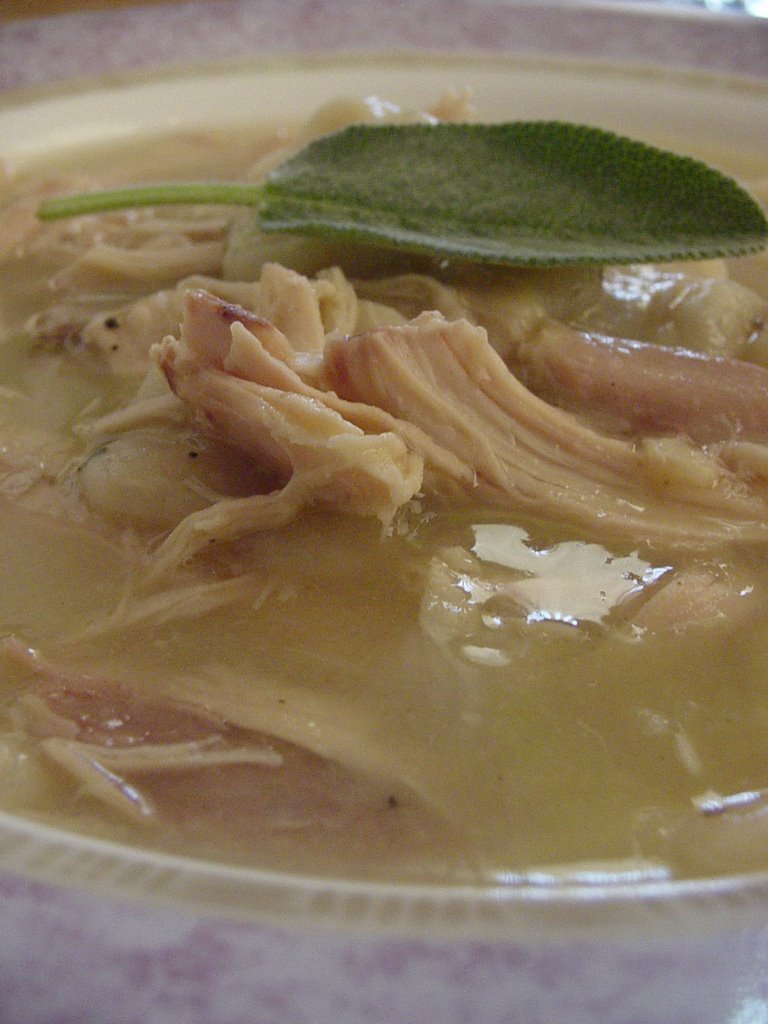
Chicken Stew with Sage Dumplings


It's finally that time of year when the cold fronts move through Texas and cool us off a little. But when those fronts move through and the air gets a little crisp in the mornings, it makes me want to eat something very special that my mother only makes once in a blue moon. She has withheld the recipe for this particular treat for all of my 28 years until I have finally figured out how to make it. And what is this delectable treat that makes my mouth water at its name? Chicken and Dumplings. Yes, something so simple makes my stomach growl in anticipation hours prior to the meal. And now I finally have a recipe.

When making the dumplings, you have several options. Option 1: Cut the dough into strips 1x4". Option 2: Use a 1½" biscuit cutter to make little rounds of dough. Option 3 (the one I used): Use a fancy Japanese cutter to make little flowers. All of these will yield the same delicious results. My mom uses option 1 since it's the easiest.

Chicken Stew with Sage Dumplings

1 (5-pound) stewing chicken
1 rib celery (including leaves), cut in thirds
1 small onion, quartered
1 carrot, cut in half lengthwise, then into thirds
15 leaves fresh sage
Sea salt and freshly ground black pepper
2 cups all-purpose flour
1 tablespoon baking powder
¾ teaspoon salt
3 tablespoons unsalted butter
1 cup whole milk
8 large leaves fresh sage, chopped finely
3 tablespoons cornstarch

Remove any internal organs from chicken and place in a large pot. Stuff cavity with 10 sage leaves. Add celery, onion, carrot, and 5 remaining sage leaves to the pot. Add water to cover chicken. Heat to boiling over high heat, then reduce heat to medium and simmer for an hour and a half, or until chicken is tender.

Remove chicken from broth and let cool. When chicken is cool to the touch, remove skin and discard. Pull meat from the bone in finger-size chunks and set aside. Discard bones (or use them to make chicken broth for other dishes). Cool chicken broth and refrigerate until fat collects on the top. Strain the fat from the top and then return the broth to the heat. Add chicken back to the broth.

Combine flour, baking powder, salt, and sage in a medium bowl. Heat butter and milk over medium heat until milk is hot and butter is melted. Pour over dry ingredients and stir with a fork just until moistened. Turn out onto a floured surface and, using a floured rolling pin, roll to 1/4" thickness. Cut into strips, rounds, or other shape. Bring broth to a boil. Drop dumplings in one at a time in different areas of the pot so that the dumplings do not stick while cooking. When all of the dumplings have been added, let the broth boil for another five minutes, then turn down the heat to medium.

In a separate bowl, mix cornstarch with broth from the pot to form a thin paste. Add back to the pot and stir until the whole mixture thickens moderately. Serve hot.

Sunday, October 15, 2006

Bento Boxes: Gyūniku Dango (Glazed Beef Meatballs), Kinoko no Nimono (Quick Braised Mushrooms), Kabocha no Nimono (Simmered Pumpkin)


Since I had so much fun with the first bento box, I figured I'd go for another fun lunch for the week.  I managed to find some great kabocha pumpkin at the store, so that was definitely going in.  I decided to try some meatballs this time, and they're delicious with the sweet glaze.

Gyūniku Dango (Glazed Beef Meatballs)
From Bento Boxes: Japanese Meals on the Go by Naomi Kijima

¼ onion, minced
½ teaspoon cooking oil
3 ounces ground beef
2 teaspoons beaten egg
2 tablespoons breadcrumbs
Salt and pepper
Oil for deep frying
2 teaspoons soy sauce
½ teaspoon each granulated sugar, mirin, and sake
3 tablespoons water
4 quail eggs, hard-boiled

Sauté the onion in the oil until translucent. Let cool. Combine the ground beef, cooked onion, egg, breadcrumbs, salt, and pepper. Knead well.  Form into small balls. Deep fry at 340°F for 2 to 3 minutes until well browned. Place meatballs in a pan with all remaining ingredients except the quail eggs. Boil 4 to 5 minutes. Place the meatballs on short skewers, alternating with quail eggs.

Kinoko no Nimono (Quick Braised Mushrooms)
From Bento Boxes: Japanese Meals on the Go by Naomi Kijima

½ tablespoon soy sauce
1 teaspoon mirin
3 tablespoons water
¾ ounce shimeji mushrooms, with stalks

Bring liquid ingredients to a boil and add the shimeji.  Cook briefly, then drain.

Kabocha no Nimono (Simmered Pumpkin)
From Bento Boxes: Japanese Meals on the Go by Naomi Kijima

3 ounces pumpkin (kabocha squash)
1 tablespoon granulated sugar
1 teaspoon soy sauce

Dice pumpkin in ¾-inch cubes.  Shave off the sharp edges. Boil in a small amount of water for 4 to 5 minutes. Add the sugar and continue cooking. When tender, drizzle with soy sauce.

Sunday, October 08, 2006

Bento Boxes: Hotate no Teriyaki (Teriyaki Scallops), Kabu no Shoyuzuke (Soy Turnip), Yamagobo (Gobo in Vinegar)


What could be more fun than a bento for lunch?  The answer, in case you're wondering, is nothing.  I actually look forward to my lunch if there's a little box full of goodies waiting for me.  These are two bentos that I made based on recipes from Bento Boxes by Naomi Kijima.  Give them a try and see how much more fun your lunch can be.

Hotate no Teriyaki (Teriyaki Scallops)

5 large sea scallops
1 tablespoon soy sauce
1 teaspoon granulated sugar
1 teaspoon sake
1 tablespoon water

Trim the scallops. Bring the remaining ingredients to a boil. Add the scallops and cook 3 to 4 minutes until well-glazed.

Kabu no Shoyuzuke (Soy Turnip)

1 turnip with leaves
1 teaspoon soy sauce

Remove the turnip leaves, leaving ½-inch of stem. Peel the turnip and cut into wedges. Toss with the soy sauce.

Yamagobo (Gobo in Vinegar)

1 (4¾-inch) piece gobo (burdock root), peeled
⅓ cup dashi stock
1½ tablespoons white vinegar
2 teaspoons granulated sugar
Salt
Roasted sesame seeds

Cut the gobo crosswise into 3 pieces.  Slice lengthwise and blanch.  Stir in the dashi, vinegar, sugar, and salt.  Cook for 5 minutes.  Sprinkle with the sesame seeds.